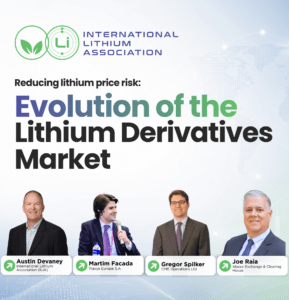

Increasing lithium price transparency
The price of lithium is one of the most important and debated subjects in our industry. Lithium is a specialty chemical and the industry is truly global, so estimating a benchmark price for a representative lithium product is a very complex challenge. Does anyone really know the price of lithium?
As Albemarle’s Ellen Lenny-Pessagno explains in our quarterly interview (see p.12), “Prices are the bedrock of market decision-making, [but] the historical reliance on long-term contracting in lithium has posed challenges for the development of robust benchmark prices that accurately reflect market dynamics. This can make benchmarking prices challenging for automakers, traders and other stakeholders.”
A maturing industry
It is often said that the lithium industry is a relatively young one. Although lithium has been industrially produced since 1924 (see Lithium Voice #4), the market only really took off in the 2000s as rechargeable batteries became commonplace.
Today rechargeable lithium batteries are essential for electric vehicles (EVs) and energy storage systems which enable us to decarbonise. Over 85% of lithium supply is used to make batteries compared with just 23% in 2010. At that time most lithium was used for specialised industrial applications like glass, ceramics and lubricating greases (see Lithium Voice #2). The market is growing rapidly and the forecast for future growth is also strong, with the analyst Wood Mackenzie expecting demand for lithium to increase fivefold by 2040.

However, this rapid evolution of the market can create supply and demand imbalances since new lithium mines, refineries, battery factories and electric vehicle plants are not being built in the same areas, let alone at the same time. When demand-supply imbalances occur the price of lithium can fluctuate. One such imbalance happened in 2023, when demand for lithium outpaced supply resulting in a rapid rise in spot prices mid-year, before they subsided again.
Although such price variations are not unusual, even in mature markets, the lack of predictable prices can lead to difficulties raising the investment capital which is critical for new mining and refining projects. It is therefore extremely important for market participants to both understand current prices and to mitigate the risk of future price changes.
There are two ways market participants strive to better understand prices, price reporting agencies and auctions, and two ways they work to stabilise the prices of their goods – and therefore their cashflow – off-take agreements on fixed (or semi-fixed) prices and using exchange-traded lithium futures contracts (agreements to buy or sell material for a particular price on a future date).
Long-term agreements and spot prices
Traditionally most lithium supply is sold on large tonnage, multi- year contracts known as off-take agreements. These contracts have a price which is usually fixed for the duration of the contract, but may be allowed to fluctuate (float) between a floor price and a ceiling price. The price is negotiated directly between sellers and buyers and it is not unusual for a chemical specification to be included in the contract terms.
Off-take agreements offer both buyer and seller a predictable financial transaction and are common in many industries, especially those with specialised products or a limited number of producers. Historically lithium had both of these conditions and participants used annual contracts as a way to lock-in prices and mitigate risk.
In the last decade the lithium industry has grown considerably and off-take contracts are still commonplace, but for another reason – the number of new mining projects.
New mining projects are expensive and take several years to start production, so a long-term off-take agreement which locks in future income gives investors confidence in the return on their investment. According to Anand Sheth, ILiA’s Founding Chairman, who advised several successful new lithium mining projects, “Investors would require greenfield mining projects to secure long-term off-take agreements for the total [lithium production] volumes and with additional conditions of floor and ceiling prices as a condition of their investment. Without debt, no new project could be developed.”
However, today fixed pricing is a thing of the past and lithium is increasingly sold at prices based on a market index. The contract price is linked to floating price mechanisms that may include floors and ceilings to allow for quarterly or even monthly adjustments, tracking changes in the spot price of lithium.
The spot price is the cash cost for short-term purchase and delivery, reflecting the marginal cost of buying or selling a lithium unit in the prompt market. In the lithium market at least six price reporting agencies (PRAs) publish estimated lithium prices regularly. The spot price for lithium carbonate in China is considered by some market observers as a benchmark for the industry given the country’s strong position in the downstream lithium business.
However, there is constant debate, analysis and speculation about prices since there is no such thing as a “standard” lithium carbonate or hydroxide product. Lithium is a specialty chemical and many consumers require specific grades.
For example, technical grade lithium, which is used in the glass, lubricants and steel industries, is a relatively standard product, although is still far from being homogenous. However, battery manufacturers are particularly demanding and will typically stipulate numerous variables such as the maximum level of impurities allowed. Their strict certification requirements for raw materials can see a new producer can take up to 2 years to be approved to deliver battery-grade lithium.

In other words, it is extremely difficult to estimate the weighted average price of a generic lithium product at any moment, although that doesn’t stop the PRAs from trying. Fastmarkets, a UK-based PRA (and member of ILiA), has a team of 12 people who assess different price data points daily to build a reference price.
Despite these herculean price discovery efforts, there is a perceived lack of price transparency in the market since the contracts are not public. This hinders the ability of investors to assess the risks and returns related to new projects. It should not be a surprise to learn that as the lithium market has expanded, new pricing mechanisms are emerging to cater to greater market liquidity. This can help producers too; while fixed-price off-take agreements work in periods of stability, they make it difficult for producers to take advantage of the higher value of their product if prices rise suddenly, or to avoid operating at a loss if their costs increase (and for consumers, vice versa).
Contracts for future lithium
Futures contracts are agreements to buy or sell assets at a predetermined price and date, and may be for delivery of physical material or purely a financial transaction (‘cash settled’). The first futures contracts were developed for agricultural products like rice and corn in the eighteenth and nineteenth centuries, respectively. Since then financial exchanges have developed many futures and other sophisticated instruments that allow buyers and sellers to manage and mitigate financial risk, and recently they have been developed for lithium too.
The ability to hedge against price volatility can allow a lithium producer to lock in sales income and stabilise cash flow. The ability to hedge also incentivises the allocation of investment capital for new raw material projects and banks are more likely to provide project finance when the pricing risk associated with the future production of the project is hedged.
Consumers like futures too. Electric vehicle manufacturers and consumer electronics companies need to source large volumes of battery metals including lithium, nickel and copper and any volatility in the prices of these materials adds to their financial risk. Consequently these end-users commonly use futures to lock in their costs, for example hedging copper with the CME Group’s COMEX.
Ron Mitchell, Chair of the LME’s Lithium and Cobalt Committee, told The Lithium Voice: “The biggest challenge for the lithium industry is raising investment capital as the debt market is not active in the sector. Banks don’t have lithium experts who can forecast lithium prices so futures contracts provide a much needed risk mechanism.”

Five years ago CME Group and the LME launched lithium futures contracts in response to the growth in the lithium market and the needs of participants including financiers and end-users like the automotive industry. Since then several other exchanges have followed increasing the range of hedging mechanisms available to market actors, including for physical delivery.
Global exchanges offering lithium futures contracts
A centralized marketplace can provide better opportunity for price discovery and transparency. Lithium reference prices are central to the dynamic contracts being developed by CME Group (CME Globex), Guangzhou Futures Exchange (GFEX), the London Metal Exchange (LME) and The Singapore Exchange. These futures contracts are cash-settled using Fastmarkets reference price with the exception of GFEX which is delivered physically. More contracts are in the pipeline including a lithium contract with physical settlement being developed by Abaax Exchange in Singapore.

Trading in lithium futures contracts is growing steadily, reflecting the fact that investors need price visibility and risk management tools in order to de-risk their investments and provide funding for new projects. To Szetoo Yuway, Sales & Futures Senior Director at major lithium producer Tianqi Lithium, the benefits this offers the industry are clear. “Exchange[s] provide effective price risk management tools for upstream and downstream in the lithium industry, enhancing the market’s price discovery function, which contributes to the stabilisation of industry chain”.
While the evolution of the lithium futures market shows considerable promise, it is important to note that unlike a sheet of copper or an ingot of zinc, specialty lithium chemicals need careful handling and storage. For example, lithium hydroxide is hygroscopic, naturally absorbing water vapour from the air. According to Chengxin Lithium, battery grade lithium hydroxide typically has a shelf life of six months from the date of production. Similarly, for standard delivery the GFEX only accepts lithium carbonate with a production date that is within 60 days (inclusive) from the delivery date.
Digital price discovery
To augment the traditional price discovery by PRA journalists, in recent years digital auctions have emerged, offering occasional flashes of transparency, albeit for relatively small tonnages.
Pilbara Minerals occasionally sells parcels of its unallocated spodumene concentrates to the spot market using its Battery Material Exchange (BMX) platform. During the period of rising prices in 2023 the BMX offered a tantalisingly transparent proxy for the market as a whole, but in March 2024 the company explained that “[since the] forecast production volume for calendar year 2024 is now largely allocated, regular future spot sales via BMX during 2024 are unlikely”.
Another raw material trading platform where producers can sell material is Metalshub, based in Germany. This site has been used by Albemarle several times this year to sell some of its chemical-grade Australian spodumene concentrates and battery-grade carbonate.
“The primary reason for holding these bidding events is to is to bring price transparency to all lithium market participants… Our aim is to foster a more efficient, sustainable, and investible supply chain,” Lenny- Pessagno told The Lithium Voice.
A third Australian lithium producer, Mineral Resources, also plans to sell on a digital platform.
While digital auctions undeniably offer transparency to those participating in the trade and have the advantage of being based on actual sales, the extent to which they could illuminate the market for a benchmark lithium product remains a question for the future.

Looking ahead
Futures and other forms of price discovery are important steps for the industry and reflect the growth and critical role of lithium in the shift to decarbonised transport. As the market for lithium products matures financing options for new projects and the battery value chain are expected to increase and exchange-traded lithium futures are likely to be part of this landscape. Przemek Koralewski, Global Head of Market Development at Fastmarkets told The Lithium Voice that “the trajectory of the lithium market could be similar to iron ore which evolved from a cash contract market to one with future contracts valued at more than three times the physical market [over several decades].”
A broader lithium financing market could have positive outcomes for both the battery industry and the energy transition as a whole. Certainly there is strong support for greater price transparency and hedging mechanisms from the main EV manufacturers who are already able to hedge the prices for most of their other battery raw materials.
It is not for The Lithium Voice to predict market developments, however historical trends show that new pricing mechanisms develop as industries grow in size and the number of participants. It would be unusual if the pricing of lithium – albeit a specialty chemical – were not to follow a similar path.
Note: ILiA’s Antitrust and Competition Law Guidelines forbids it to discuss future lithium prices.