

The story of lithium is as old as time itself, but until recently key details about where lithium came from were a mystery.
The first lithium atoms were created when the universe was formed 13.8 billion years ago at the cosmic dawn, in the event known as the “Big Bang”. However, while no other metal can claim an ancestry as ancient as lithium, there is a catch: lithium atoms are fragile and typically get destroyed in the burning core of a star. This means that for billions of years, lithium has been steadily destroyed and yet there is still an abundance of lithium – far more than could be explained by the Big Bang alone.
Clearly, lithium was being created in other ways too, but how and where this happened was a mystery.
Scientists debated for decades, and several theories offered partial explanations, but it was only in 2020 that the final piece of the puzzle was found: classical novae. “Given the importance of lithium, it is nice to know where this element comes from,” said Sumner Starrfield, who is a Regents Professor with the ASU School of Earth and Space Exploration and leads the classical novae project.
Origin #1 The Big Bang
Around 13.8 billion years ago the Big Bang created time and space as we know it. From an infinitely hot and dense single point, a singularity, the universe expanded faster than the speed of light for a fraction of a second, before settling back to a more modest rate of expansion which continues to this day.
At one second old, the universe was a 10-billion-degree (°K) sea of cosmic particles; neutrons, protons, electrons, anti-electrons (positrons), photons, and neutrinos. As the universe continued to expand this hot, dense plasma cooled and within minutes the fundamental particles had started joining together to form atoms, a process called big bang nucleosynthesis (BBN).
The majority of these atoms, some 75%, were forms of hydrogen (including deuterium and tritium), while almost everything else was helium. A tiny amount, just 0.00000007%, became beryllium-7, but this is a short-lived, unstable isotope with a half-life of just 45 days. As quickly as beryllium-7 was formed it started to decay into lithium-7, which is a stable isotope and the most common form of lithium found in our galaxy today.
After the Big Bang very little happened for around 380 million years and for eons the lithium atoms waited patiently in the dark for their time to come. Eventually giant gas clouds collapsed under their own gravity, becoming dense enough to form the first small, pale stars, and for the first time light appeared in the universe.
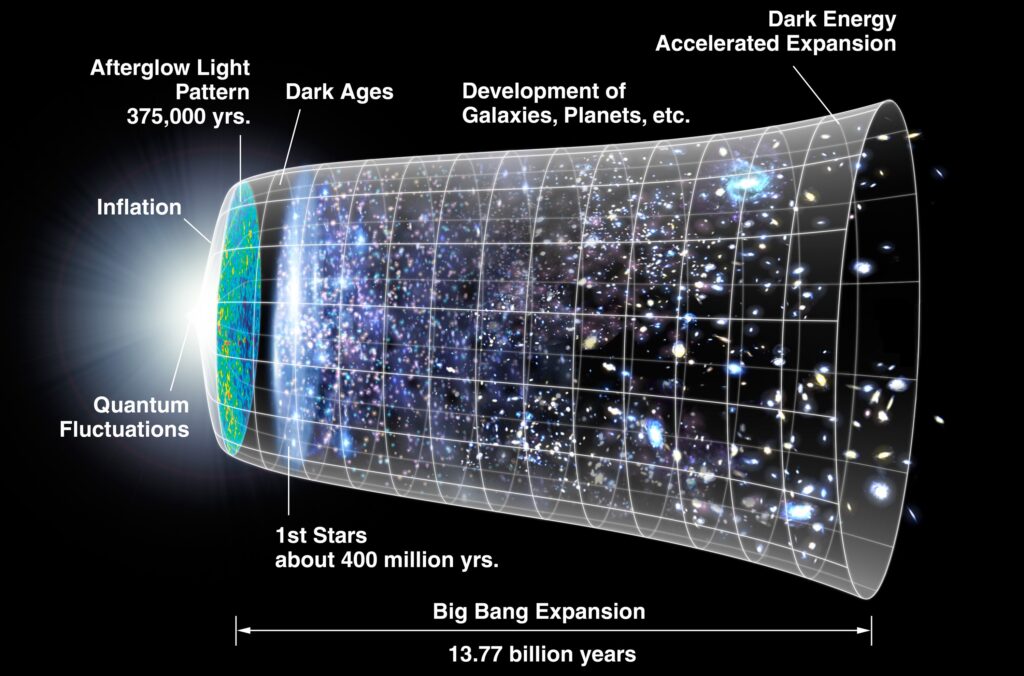
However, for lithium the appearance of stars was not an entirely positive development. The lithium atom is exceptionally fragile compared with other atoms; with just three protons in its nucleus and a very loosely held outer electron. Unlike the heavier elements which are created by a star’s nuclear reactions, lithium atoms are destroyed by them. This would suggest that the total quantity of lithium has been steadily decreasing since the Big Bang. But has it?
To find the answer, it is necessary to estimate the quantity of lithium in the universe today and compare it to the theoretical Big Bang model. For this, scientists turned to asteroids and comets, the frozen relics from the earliest days of our galaxy. From analysing their chemical composition, it was estimated that the quantity of lithium in our galaxy is around 1,000 solar masses worth. In contrast, the quantity of lithium created by the Big Bang in our galaxy is estimated to be 80 solar masses worth or just 8% of the total.
Therefore, while no other metal is as ancient as lithium, some 92% of the lithium we have today was not created in the Big Bang, but in more recent times and by other methods.

Origin #2: Red giants
One theory of how lithium is made focuses on vast, cool, dying stars known as red giants.
For the majority of a typical star’s life it will burn hydrogen into helium using nuclear fusion. Our own star, the sun, is at this ‘main sequence’ of its life and fortunately for us it will continue in this condition for several billion years.
However, in stars similar to our sun, once all the hydrogen in the star has been burned into helium, the helium will start to ‘burn’ into carbon. The change of fuel triggers a massive release of energy which causes the star to expand many times its original size and develop a distinctly red colour; it becomes a red giant.
In the core of the red giant nuclear reactions continue to make new atoms, including beryllium-7, the unstable isotope which decays into lithium-7. Normally, lithium-7 would immediately be destroyed in the core of a red giant. However, in a small percentage of red giant stars high concentrations of lithium have been observed on their surface. This process is believed to be the result of convection circuits within the star which transports beryllium-7/lithium-7 from the core outwards to the cooler surface layers before the lithium-7 is destroyed.
The death of a red giant is the most violent time in a star’s life. Smaller red giants eject material from their outer layers in a series of fierce explosions and collapse to form white dwarfs; larger red giants burn ever heavier elements until they eventually explode to form a massive supernova. Either way, the lithium is expelled into interstellar space.
It is estimated that red giants made around 100 solar masses worth of the lithium found in our galaxy, around 10% of the total.
Professor Sumner Starrfield: The genesis of a theory
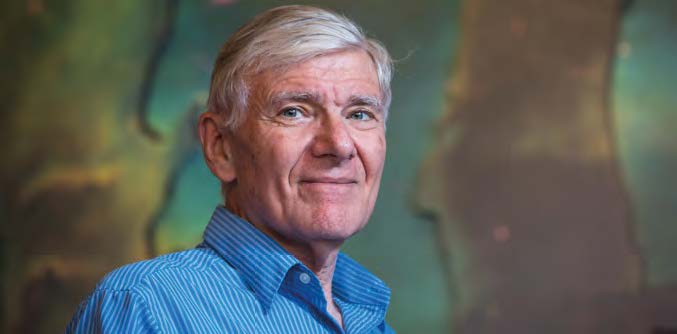
Talking exclusively to The Lithium Voice, Prof. Starrfield recalls how he first theorised that lithium might be created in classical novae:
“The idea goes back to A. Cameron and W. Fowler’s paper “The Creation Of Superrich Lithium Giants” (ApJ, 164, 111, 1971) that proposed that if you could make beryllium-7 in the star’s nuclear fusion regime and mix it rapidly to the surface, it could live long enough to decay to lithium-7. They did it for red giant stars, and it was Marcel Arnould in Belgium who first thought it was possible to make it in classical novae too and suggested that we look for it.
My computer code has a lot of low-mass isotopes in the calculations because they are necessary to accurately predict the energy production processes. I then did some simulations and, indeed, found that a large amount of beryllium-7 reached the surface, survived and decayed to lithium-7. We published this in 1978 and then in the 1990s, Jordi Jose and Margarita Hernanz redid our calculations with more details and confirmed our results.”
It is believed that cosmic rays produce practically all the isotope lithium-6 (with three neutrons) in our galaxy, but since lithium-6 accounts for under 8% of all lithium it still leaves a great deal of material to be accounted for.
Origin #3: Cosmic ray spallation
Another theory of the origin of lithium relates to cosmic rays; the charged particles which travel at speeds approaching that of light. Sources of high-energy cosmic rays include the remnants of supernovae, such as the Crab Nebula, black holes, pulsars and white dwarf stars.
Due to their incredible speed cosmic rays carry immense energy and when they collide with an atom, they shatter it into pieces.
When cosmic rays hit large atoms, the process of creative destruction can sometimes create the three lightest elements, beryllium, boron and lithium, which are not able to be made in stars.
Origin #4: Classical novae
The final piece of the lithium puzzle was only widely accepted in 2020 when new evidence was published which elegantly explained how the rest of the lithium in the galaxy had been made; classical novae, a class of stellar explosions.
The team, led by Professor Sumner Starrfield at Arizona State University, examined binary systems where a pair of stars orbit each other. The stars in binary systems naturally burn through their fuel and grow old, as all stars do, but sometimes one of the pair will still be at the hydrogen-burning stage, like our sun, when its companion has already developed into a white dwarf, a stellar remnant that has the mass of our sun, but a dense core of carbon and oxygen and is only the size of Earth.
In this situation the white dwarf’s gravity draws off loosely held gaseous material from its companion star and onto itself. These stolen clouds of hydrogen and helium build up on top of the carbon-oxygen surface of the white dwarf, getting denser and denser until the quantity is so great that an ignition point is reached and an explosion, or nova, happens. For a short time nuclear fusion occurs across the white dwarf’s surface, producing new elements, including beryllium-7 (and therefore lithium-7), before the nova ejects them into space.
This may sound rare, but our galaxy holds over 100 billion stars and approximately 50 develop into classical novae each year, giving Starrfield and his team a wealth of observations to support this theory. Observations by the Japanese Subaru telescope in Hawaii and the EU’s Very Large Telescope in Chile have both detected and measured beryllium-7 from these classical novae, while lithium-7 has been directly measured in the afterglow of a novae using the Large Binocular Telescope in Tucson and Ohio State.
Further supporting evidence is provided by analysis of pre-solar grains of dust by the isotope cosmochemist Professor Maitrayee Bose who works at ASU’s School of Earth and Space Exploration. Her work analyses meteorites and interplanetary dust particles that contain tiny rocks that formed in different kinds of stars. “A small fraction of stardust in meteorites formed in novae,” Bose said. Finding pre-solar grains, therefore, could provide a direct link to classical nova outbursts. “We have found some that have been virtually unchanged since their formation and then the formation of the Solar System,” explained Starrfield.
“This is ongoing research and while we continue to work on theories, we’re looking forward to when we can use NASA’s James Webb Space Telescope and the Nancy Grace Roman Telescope to observe novae and learn more about the origins of our universe” Starrfield concluded.
At last, it seems that the mystery of the origin of lithium has been solved.