Prof. Richard Herrington is a geologist and for a decade was Head of Earth Sciences at the Natural History Museum in London, UK. In 2022 he took up an exciting role leading a new research area – Resourcing the Green Economy. Herrington is an Honorary Fellow of ILiA.
How did you get interested in minerals?
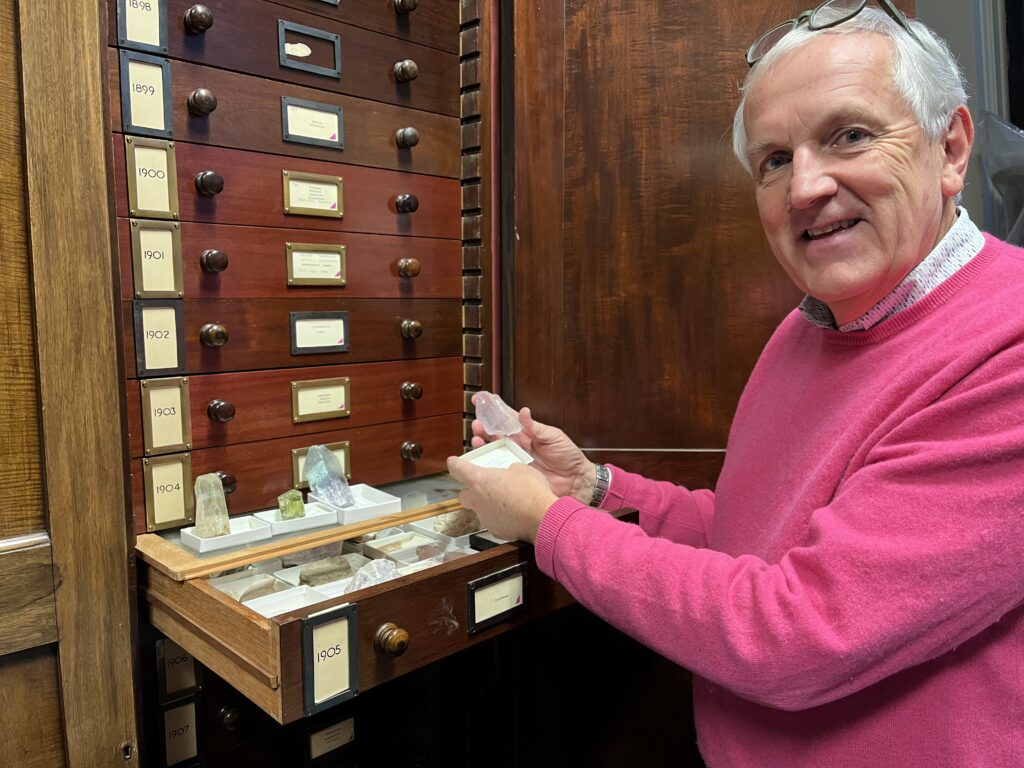
When I was a boy on holiday in the Tamar Valley in Cornwall, I went to the old tin mine at Gunnislake [an important nineteenth-century tin-copper-tungsten-arsenic mine] and found minerals on the dump and started a collection. I became interested in physical geography and was fortunate to have a teacher, who recognised that my real interest was geology.
How did you get involved with lithium?
In 2019 my colleagues and I were working on a project related to the security of supply of critical materials, but lithium was not on the list. At a meeting at the Royal Society in London I did a back-of-the-envelope calculation of the costs for the energy transition. I estimated that we needed the entire global production of lithium to meet the transition to electric vehicles in the UK alone!
It was clear that we needed a project focussed on lithium, so a group of us led by Dr Kathryn Goodenough [the Principal Geologist at the British Geological Survey] forwarded an idea for a ‘highlight topic’ on the metal to the UK research council NERC which was adopted and from that we wrote a research proposal. That was successful and LiFT (Lithium for Future Technologies) was born. We investigate geological resources with potential to produce lithium, including Li-clays in the USA and Turkey, Li-rich borates in Serbia and Li-micas in granites and pegmatites across Eurasia, Africa and Australia.
I am the principal investigator on volcanic sedimentary hosted deposits. We have worked on Jadar in Serbia and also the Jindalee deposit in the McDermitt Caldera system in the US. McDermitt is probably the world’s largest lithium deposit at the moment with a potential resource of over 60 million tonnes. None of those types of deposits are in production yet.
How was the Natural History Museum involved in the discovery of the Jadar lithium resource?
In 2004 Rio Tinto was exploring for boron in Serbia. They intercepted a big accumulation of boron which was within a very unusual white mineral. They knew it contained lithium, but they didn’t know what it was, so they sent a sample to my minerologist colleague, Dr Chris Stanley. He realised it was a completely new mineral and named it jadarite after the region where it was found.
How can the mining industry increase stakeholder engagement?
The mining industry has frequently operated in silos and has often failed to engage with the right stakeholders from the start. Exploration is a loss-making exercise and miners have often had the view that they’ll talk to the local community after a discovery not before. We should look at mining as a temporary intervention to recover minerals from the sub-surface and acknowledge that this is only a part of the natural capital of the site. That natural capital includes the people and the biodiversity too. A mining project needs to have all the parts involved from the get-go, it needs tovalue the environment, the biodiversity and to co-design the project with the people who will be impacted. An example of a company doing the right thing now is SQM [the lithium producer] which is engaging and working with local communities in Chile.
What is cradle to cradle mining and is it applicable to the lithium industry?
With a cradle-to-cradle approach when a mining project ends, you don’t leave a graveyard but something like a sustainable landscape or an industrial park. Even 100 years of mining is a short period of time in many people’s memories. Indigenous people talk in timescales of thousands of years, so mining companies need to design projects where the end game is as important as the mine opening. That is not to say that locals will accept mining, but local buy-in comes if there is a benefit and, at the end of the project, they get their land back or nature gets it back. A project needs to have a positive top line of the three Es (economics, environment and equity) to be successful.
Everything taken out of the ground needs to be used even if only for reconstructing the site. Cradle-to-cradle doesn’t mean that the site has to go back to what it was at the beginning. We have to accept that there will be changes. But the site should be useful for something.
I was talking with a European junior lithium miner that plans to sell all the waste as aggregates for the construction industry. The lithium industry is well placed to incorporate cradle-to-cradle values as lithium deposits are generally not associated with problematic waste materials. The end game for lithium deposits in clay is to return materials that are relatively benign to repurpose the site whether for re-wilding or conversion to an industrial park.
In the UK lithium companies are extracting something that was left behind when clay was being mined. The Eden Project [botanical garden] is a fabulous example of what you can do with an old china clay mine. If the Cornish Lithium and British Lithium projects go ahead, the chances are that their post mining landscapes will be a big improvement on what they inherited.

Do you drive an electric vehicle?
I do! My Volkswagen ID3 is comfortable, easy to drive and performs well. I would never go back to an internal combustion engine. It’s hooked up to the solar panels on the roof making it cost effective to run.
What is special about lithium?
The minerologist in me loves the beauty of gem-quality spodumene known as kunzite. It’s a fabulous mineral with a beautiful pink colour. I love the fact that something so practical can also be beautiful. Spodumene is one of the primary ore minerals of lithium containing a theoretical maximum of 8.03% Li2O.
What message to do you have for ILiA members?
It is an exciting time for geologists with a chance to work on new types of lithium deposits. What need to ensure that we match the discovery effort with research on how to recover lithium from the discovered unconventional sources and to make sure we have methods to recycle lithium from end-of-life products, so we don’t waste what we have extracted from the earth.