Lithium, like sodium and potassium, is never found in nature as pure metal and most applications for lithium use it as a lithium compound. However, recent developments in lithium metal batteries could require large-scale lithium metal production in coming years.
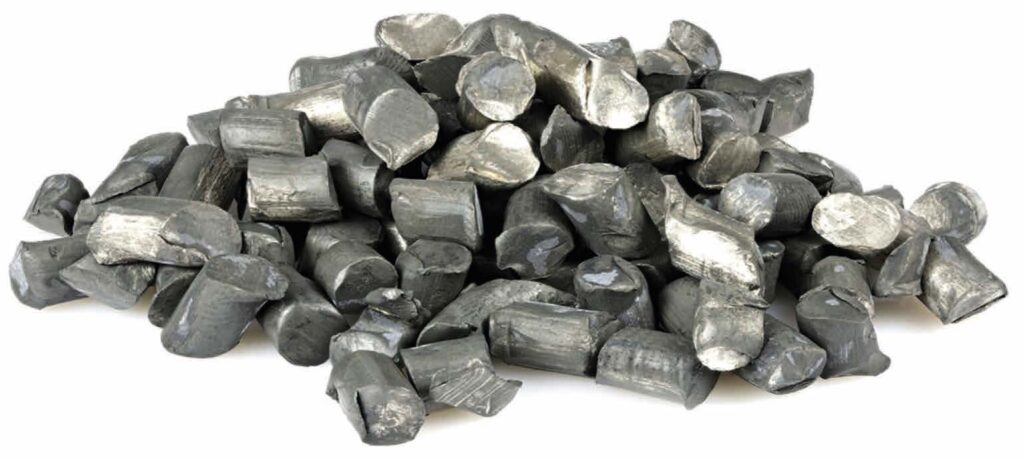
A silver-grey metal
Lithium is the lightest metal in existence, with a density of only 0.534 grams per cubic centimetre. This is around half the density of water and an ingot of lithium metal would float on top of water. However, if lithium metal doesn’t have a protective coating it will react with the water vigorously, transforming itself into lithium hydroxide and generating hydrogen gas in the process. Do not try this at home.
Lithium is a silvery-white alkali metal (group 1 in the periodic table) which is soft enough to be easily cut with a kitchen knife. Once cut, however, it will quickly start to turn black as it reacts with the oxygen in the air.
For a light, soft metal lithium is remarkably malleable and ductile. If it is handled in a protective atmosphere, for example in a chamber of unreactive argon gas, lithium can be drawn into fine wires or pressed into sheets that are surprisingly robust.
Historically lithium metal was used in an alloy of lead (‘Bahnmetall’) and more recently in aluminium- and magnesium-based alloys for aircraft, aerospace and the military vehicles.
Another traditional use was in non-rechargeable batteries, which come in a range of sizes, including small button cell used domestically in car key fobs and elsewhere (pictured below), and the batteries for surgically implanted heart pacemakers that are required to operate for at least five years without replacement.
The current market for lithium metal is small compared to that for lithium carbonate and hydroxide. According to David Merriman, a lithium analyst at Project Blue, the global production of lithium metal in 2024 was under 3% of the total lithium market, and was mostly produced in China.

However, the market for lithium metal is growing rapidly and shows great potential thanks to advances in next-generation solid-state lithium batteries that are being developed for electric vehicles (EVs), energy storage, and other related fields. Many analysts predict that these batteries will require a great deal of lithium metal in the future and several companies are already investing in new capacity to prepare for the expected demand.
Producing lithium metal
For an element which never occurs in nature in its pure form, it’s not surprising to learn that producing lithium metal is challenging. In fact, it took almost 40 years after the discovery of lithium by Johan August Arfvedson in 1817 for enough lithium metal to be produced to measure its properties with confidence. This was done by two scientists independently, Robert Bunsen in Germany and Augustus Matthiessen in the UK, using electrolysis of molten lithium chloride in 1855.
Lithium metal was produced at an industrial-scale for the first time in 1923 at a plant in Langelsheim, Germany (now part of Albemarle Corporation). Production here used molten salt electrolysis too, but mixed potassium chloride with lithium chloride to obtain a mixture with a lower melting temperature (see Lithium Voice #4).
Today the smelting and purification technology of high-quality lithium metal is still a complex and delicate process because of the chemically active nature of lithium and the many technical challenges in the purification process. The first stage is (still) electrolysis of molten salt in highly controlled conditions. Once the lithium salts are in the electrolyser the temperature, current density and electrolyte composition are carefully controlled to achieve the target the purity, crystalline form and efficiency levels.
Subsequent stages of production include thermal insulation and sedimentation, precision filtration (or low-temperature distillation), and low-temperature moulding to produce high-purity metal lithium ingots.
Several companies are actively involved in developing improved lithium metal techniques. ILiA member Ganfeng Lithium has recently developed an oil-free vacuum melting production process to produce high-purity lithium metal which achieves a purity of 99.95% Li, with a good consistency and excellent surface quality.
In a parallel development Ganfeng Lithium has developed a first ever low-temperature vacuum distillation purification technology for the production of battery-grade lithium metal which has reduced the preparation energy consumption by 50% at the company’s plants in Jiangxi, Qinghai and other Provinces in China.
Lithium metal in batteries
Recent trends in the battery industry display a steady transition from semi-solid to all-solid materials. While in parallel, anode materials are evolving from being based on graphite, to being based on silicon or lithium metal.
These next-generation battery technologies improve energy storage and transport dramatically and could even transform the global energy system. According to Keiji Otsu, President of Honda R&D Co., Ltd, solid-state batteries are “an innovative technology that will be a game changer in this EV era”, and such a change will require unprecedented quantities of very thin lithium metal foil.

Exciting developments
One example of a high-end lithium metal product which has been specifically developed for solid state batteries is an ultra-thin foil just 0.02mm thick, which is less than half the thickness of a human hair. These remarkable foils are produced by Ganfeng Lithium using ternary gas protection, vertical extrusion and multi-stage continuous rolling – a process which pushes extrusion and rolling technology to the limit in order to avoid shearing the soft lithium foil.
Ganfeng Lithium is developing a range of next-generation battery products that includes a high-energy solid-state lithium battery made with lithium metal anodes. Recently the company, working with the FunLithium R&D Center, successfully developed a high-energy lithium metal battery with an energy density of 420Wh/kg and a cycle life of more than 700 charges, and initially developed a product with an energy density of 500Wh/kg. Such a battery could bring unprecedented range upgrades to electric vehicles and extend the battery life of wearables and drones considerably.
Elsewhere in the industry a plethora of firms are investing in lithium metal battery technologies:
- At the US laboratory of Pure Lithium in Charlestown, MA, they are creating a battery with a pure lithium metal anode paired with a vanadium cathode to create a safe, affordable lithium metal battery.
- In late 2024, for the first time, Honda Motor Co., Ltd unveiled a demonstration production line for -solid-state batteries in Sakura City, Japan.
- SES AI (previously Solid Energy Systems) states that it is making significant progress in lithium metal anode technology.
- In China, the state-owned automotive manufacturer SAIC Motor is developing an electric vehicle powered by batteries that use lithium metal with Qingtao Energy Development.
- Tianqi Lithium and Welion New Energy have joined forces to develop pre-lithiated negative electrode materials, lithium metal cathode and lithium base alloy cathode materials for solid-state batteries.
From the origin of the universe to essential applications of modern industry, lithium has vast potential. Until now most applications of lithium have used lithium carbonate, hydroxide and chloride, or the pure minerals. However, with new technological breakthroughs, both in the lithium battery sector and in lithium metal production, a wide range of new applications for lithium will be seen, making an even brighter future for a very special element.
ILiA appreciates the technical assistance of Ganfeng Lithium Group Co., Ltd in creating this article.